Even after the failure of their top and middle-order batters, West Indies stayed alive in the contest. With a fiery stand between Mario Shepherd and Shamar Springer, the Caribbean side began to dream of victory. Their record-breaking batting brought them close, but in the end, they couldn’t pull it off — losing by 9 runs in a nail-biting finish.

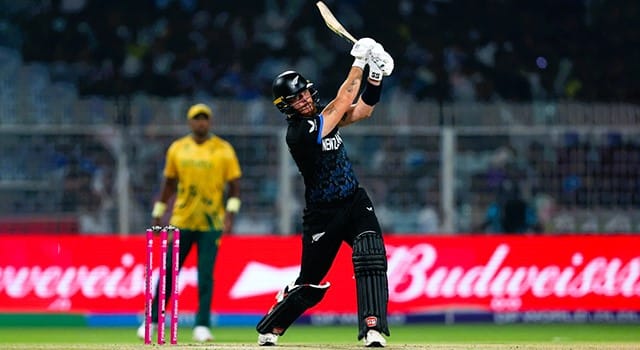
On Sunday (November 9), New Zealand won the toss and opted to bat first at Saxton Oval in Nelson. Riding on Devon Conway’s fifty, the Kiwis posted 177 runs for 9 wickets in their allotted 20 overs. Conway scored 56 off 34 balls with 6 fours and 2 sixes. Daryl Mitchell added 41 from 24 balls, while Rachin Ravindra contributed 26 off 15. For West Indies, Matthew Forde and Jason Holder picked up 2 wickets each.

In reply, West Indies collapsed to 88 for 8, seemingly out of the game. Then came a remarkable fightback — Mario Shepherd and Shamar Springer stitched together a 78-run stand, the highest ninth-wicket partnership in T20Is among Test-playing nations.

Ultimately, West Indies were bowled out for 168 in 19.5 overs. Springer made 39 off 20 balls, while Shepherd scored 49 off 34. Jacob Duffy and Ish Sodhi took 3 wickets apiece for New Zealand.

The much-debated Asia Cup trophy controversy came up during the ICC meeting in Dubai. However, contrary to fears of a heated exchange, the atmosphere remained calm. In fact, the representatives of the Indian and Pakistani cricket boards engaged in a polite and diplomatic conversation.

There had been uncertainty over the participation of Pakistan Cricket Board (PCB) chairman and interior minister Mohsin Naqvi, but he arrived in Dubai on Friday afternoon at the last moment. Although the trophy issue was not officially on the meeting’s agenda, BCCI secretary Debajit Saikia personally raised the matter. Saikia pointed out that the Asia Cup trophy was still in Pakistan and should be handed over to India soon. His tone, however, reflected a spirit of resolution rather than confrontation.

According to Cricbuzz, other member nations also supported a quick resolution to the trophy issue. A proposal was made to form a joint committee, though a final decision has yet to be taken.

India defeated Pakistan on September 28 to win the Asia Cup title, but even after a month and a half, the trophy remains in the custody of the Pakistan Cricket Board — as if a soft diplomatic match continues off the cricket field.

The ICC has finalized the host venues for the tournament, which will be jointly organized by India and Sri Lanka. However, the full schedule has not yet been announced, and according to India’s PTI news agency, it is expected to be released next week.

The World Cup will begin on March 7 and the final will be played on March 8. Similar to the 2023 ODI World Cup, the final match of the T20 World Cup will be held at the Narendra Modi Stadium in Ahmedabad. However, if arch-rivals Pakistan reach the final, the match will instead take place at R. Premadasa Stadium in Colombo.

In India, matches will be played across five venues — Arun Jaitley Stadium (Delhi), Eden Gardens (Kolkata), Wankhede Stadium (Mumbai), M. A. Chidambaram Stadium (Chennai), and Narendra Modi Stadium (Ahmedabad). In Sri Lanka, games will be hosted at three venues, including Colombo and Pallekele.

Due to the longstanding suspension of bilateral series between India and Pakistan, all of Pakistan’s matches will be played in Sri Lanka. Earlier this year, during the Champions Trophy (February–March), India’s matches were also held in Dubai despite Pakistan being the official host.

Like the 2024 T20 World Cup, the 2026 edition will feature 20 teams. According to the tournament format, there will be four groups of five teams each, with every team playing against the others in its group. The top two teams from each group will advance to the ‘Super Eight’ stage, divided into two groups of four. The top two teams from each Super Eight group will then progress to the semi-finals.

All 20 teams have already been finalized after regional qualifiers, and Italy will participate in a World Cup for the first time in history.

Laura Wolvaardt — a 26-year-old woman of stunning beauty, a name that evokes grace and strength. She could have easily been a Hollywood or Bollywood star. She could have become one of South Africa’s most popular singers. But she chose a different path — the path of cricket.

Now the captain of the South African women’s cricket team, Wolvaardt is among the finest cricketers of the modern era. Many even call her the best in the world right now. Her performances over the past two years clearly show that she has surpassed the likes of Alyssa Healy, Smriti Mandhana, and Heather Knight.

Although South Africa reached their first-ever Women’s ODI World Cup final, they could not lift the trophy. Yet, Wolvaardt’s composed and responsible batting captured everyone’s attention. Even after scoring a century in the final, she could not celebrate with the trophy — and that’s why she is often called the “tragic hero” of women’s cricket. For the past two years, she has been writing a story of heartbreak.

Wolvaardt has been the top run-scorer across the last three ICC tournaments. In every final, she scored the most runs for her team. Her team may not have won, but she has won the hearts of cricket fans around the world.

Just the other day at DY Patil Stadium in Navi Mumbai, she scored a brilliant 101 runs while chasing India’s 298. But even that valiant effort wasn’t enough to secure the World Cup. After the match, while Harmanpreet Kaur, Jemimah Rodrigues, Deepti Sharma, and Shafali Verma celebrated their historic win in pure joy, Wolvaardt sat silently outside the dressing room — motionless, lost in her thoughts.

This 26-year-old played so well throughout the tournament that her name has been etched into the record books. With her 169 in the semifinal and 101 in the final, she scored a total of 571 runs in the World Cup — the highest ever in a single edition. The previous record belonged to Healy, with 509 runs.

In the 2023 T20 World Cup, she was again the highest run-scorer with 230 runs, scoring 61 in the final, which South Africa lost to Australia by 19 runs. In the 2024 T20 World Cup, she added 223 runs, including a team-high 33 in the final.

Across 119 ODIs, Laura Wolvaardt has scored 5,222 runs, including 11 centuries and 38 fifties — a remarkable record for one of the most elegant batters in world cricket.

Even though South Africa tried to make a comeback, they couldn’t withstand India’s spin attack. Laura Wolvaardt fought a lone battle with a brilliant century, but couldn’t stop India from sealing victory. Finally came that moment — the one that millions of Indians had dreamt of for years. For the first time in the history of the Women’s ODI World Cup, India were crowned champions! On Sunday, in Mumbai, Harmanpreet Kaur’s team created history by defeating South Africa in the final.

South Africa, however, can hold their heads high. The same team that had been bowled out for just 69 and 97 in earlier matches showed remarkable resilience to reach the final. Under Laura Wolvaardt’s leadership, this young and energetic side has shown glimpses that they could become even more formidable in the future.

But tonight belongs solely to India’s women — the night of fulfilled dreams, the night when the long-elusive trophy finally came within reach. As Harmanpreet lifted that golden glory, tears of joy filled millions of Indian eyes. This might well be the beginning of a new era for Indian women’s cricket — an era destined to write many more success stories.

Under cloudy skies, with rain threats and a tricky pitch, India fought bravely and played fearless cricket. Openers Smriti Mandhana and Shafali Verma gave a solid start, while Deepti Sharma and Richa Ghosh’s responsible partnership gave the innings momentum. With the ball, Deepti turned into the star, supported ably by Shafali.

South Africa, once again, tried to fight back, but India’s spin web proved too tough to break. Despite Wolvaardt’s lone century, the Proteas fell short — another heartbreaking evening, another missed chance. Yet, their fighting spirit and journey to the final deserve immense respect.

For India, this is more than just a win — it’s the realization of a long-cherished dream. From cities to villages, every street and every home is celebrating. This victory is living proof that with hard work, patience, and faith — no dream is truly unreachable.

He could have been one of the brightest stars of Indian cricket — alongside legends like Sachin Tendulkar, Rahul Dravid, Sourav Ganguly, Vinod Kambli, and Ajay Jadeja. Yet, Amol Muzumdar never became one of the shining names in Indian cricket. But he never stopped trying. Though he couldn’t make a big mark as an international cricketer, Amol became one of India’s most successful domestic players — and today, he is known as a master at creating cricketers.

At 50, Amol has chosen coaching as his profession and now serves as the head coach of the Indian women’s national team. Under his guidance, India is dreaming of winning their first-ever Women’s World Cup. The grand final will take place today in Navi Mumbai. The match begins at 3:30 PM Bangladesh time, where Amol’s pupils — Harmanpreet Kaur, Smriti Mandhana, and Jemimah Rodrigues — will face South Africa’s Laura Wolvaardt, Nonkululeko Mlaba, and Nadine de Klerk.

This will be India’s third appearance in a Women’s World Cup final after 2005 and 2017, while South Africa will be playing their first-ever final. The winner of today’s clash will become the new world champion in women’s cricket. Of the previous 12 editions, Australia have won 7 times, England 4 times, and New Zealand once. Interestingly, both India and South Africa also faced off in the final of the men’s T20 World Cup last year — where India triumphed by 7 runs in Bridgetown.

In the semifinal, Australia had put up a towering total of 338 runs. After India finished fielding, coach Amol Muzumdar didn’t say a single word to his players. He simply wrote one line on a white sheet of paper:
“Score one run more than what Australia did.”
When Harman, Mandhana, and Jemimah entered the dressing room, they saw the message pinned to the wall. That one sentence changed everything. Powered by Jemimah’s unbeaten 127 and Harman’s captain’s knock of 89, India chased down 339 with ease — a stunning performance that took them to their third final. Against seven-time world champions Australia, India were considered underdogs, but they played like true favorites.

Just like India, South Africa too entered the tournament as underdogs. In the group stage, they had been bowled out for just 69 against England and lost by 10 wickets. Yet in the semifinals, they came back stronger than ever — crushing England by 125 runs, thanks to a brilliant 169 from captain Laura Wolvaardt. The 26-year-old star has scored 470 runs in 8 matches, including one century and three half-centuries, leading the race for Player of the Tournament.

In the group stage, South Africa defeated India by 3 wickets — with Wolvaardt scoring 70 and Nadine de Klerk starring with an unbeaten 84 and 2 wickets for 52 runs. India had earlier posted 251, thanks to Richa Ghosh’s 94.

South Africa’s batting has lacked consistency throughout the tournament, with Wolvaardt being the lone steady performer. At one point, they were bowled out for just 97 against Australia. On the other hand, India’s batting lineup has been consistently strong — with Smriti Mandhana leading from the front (389 runs, 3 fifties), Jemimah Rodrigues (268), Pratika Rawal (304), and captain Harmanpreet Kaur (240). Their bowling attack has been spearheaded by off-spinner Deepti Sharma (18 wickets) and left-arm spinner Shri Charani (13 wickets).

For South Africa, Marizanne Kapp (204 runs), Nadine de Klerk (190), Tryon (167), and Luus (158) have been key contributors with the bat, while de Klerk has also taken 8 wickets with the ball.

Today is the final — a battle to crown a new world champion in women’s cricket.
Who will lift the trophy? India or South Africa?